

MENU

Inside the First Collaborative Insight Room: What the Market Is Really Telling Us

Why We Built This Room

At The Collaborative London, we’ve always believed the best investment decisions come from understanding the market, not chasing its headlines.

That belief was the starting point for the first edition of the Collaborative Insight Room, hosted on 8 July. Joining our founder Jaffar Saraj on the panel were Chris Mulry (Knight Frank), Harry Berry (Savills), Tim Jones (AlRayan Bank) and Pervaze Ahmed (Withers). Around fifty guests, wealth advisers, tax and legal specialists, and property professionals joined for what was framed from the outset as a step back from the noise.

How We Got Here

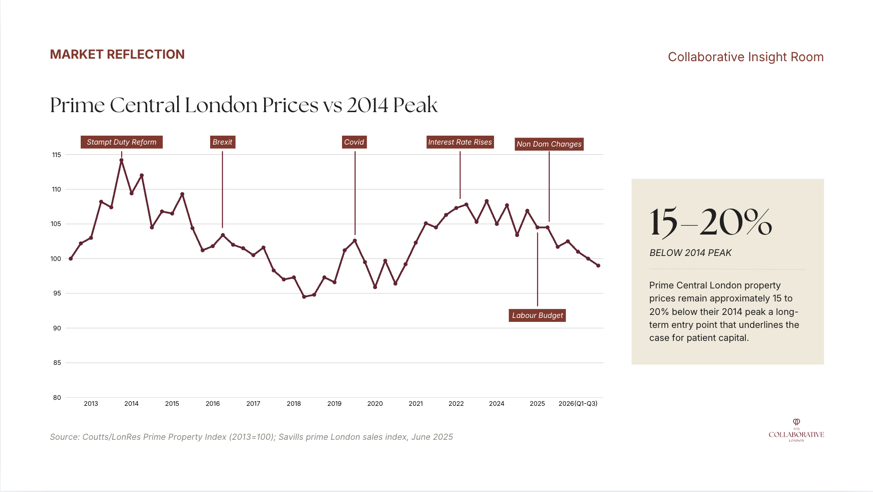
Chris Mulry set the scene with 2015, the year Prime Central London peaked, before a run of shocks reshaped the market: stamp duty reform pushed the top rate from 7% to 15%, then Brexit, Covid, sixteen consecutive rate hikes, and most recently non-dom changes taking the top rate for overseas buyers to 19%.

The result: values sit roughly 20–25% below their 2015 peak in nominal terms. Domestically-driven areas like Notting Hill and St John’s Wood have held up better; the most internationally-exposed postcodes, like Mayfair, have seen the steepest declines.

Where the Opportunity Sits

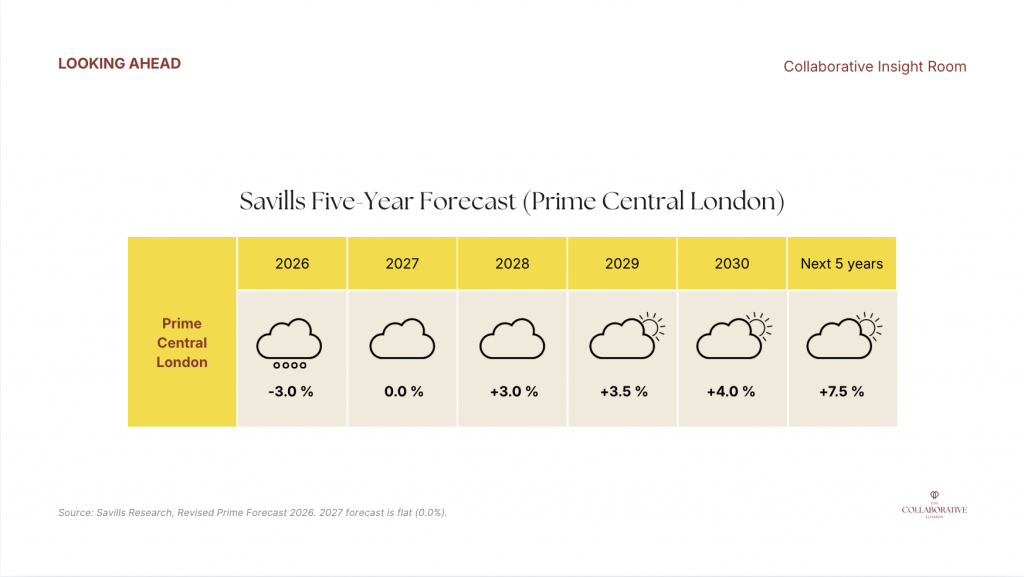
Savills’ current forecast: a further 3% down this year, flat in 2027, then steady growth averaging 7.5% over the following five years.

The transaction data tells its own story. Across Knightsbridge, Belgravia and Chelsea, volumes are up 15–20% this year, but total value is down roughly 40%, three times as many exchanges in June as last year, at an average price of around £4 million rather than £10 million. The sub-£5 million market is moving; the very top end is moving more slowly.

Harry shared a live example: a one-bedroom flat trading at roughly £2,500 per square foot, turnkey, against around £3,500 a decade ago. The panel’s broader read: buyers will still pay strong prices for genuinely turnkey homes, but have little appetite for refurbishment risk. That gap has never been wider.

GCC Investor Prospective

Tim Jones shared AlRayan Bank’s latest GCC investor research: 95% view the UK as an attractive market, 94% call it a strong opportunity over the next five years, and 99% plan to invest further or grow existing holdings. London remains the top destination, with 38% planning further investment in central London specifically. AlRayan has written roughly £600 million in new lending in the first half of the year alone, matching its entire volume for the prior twelve months.

The Legal Lens

Pervaze Ahmed’s message: for overseas buyers, structure matters as much as the transaction itself. Tax changes have made this a first-order decision, and many high-net-worth clients who’ve relocated abroad are choosing to keep their UK homes rather than sell.

What the Room Wanted to Know

The liveliest exchange came from the floor: could stamp duty be replaced with an American-style annual property tax? The panel agreed it could improve market fluidity, but the difficulty of valuing London’s uniquely varied housing stock makes near-term implementation unlikely. Incremental council tax reform is the more probable path. One real risk flagged: if reform is signalled but delayed, buyers may simply pause and wait.

The rental market prompted real debate too. Recent tenancy reform has made small-scale buy-to-let harder to justify, and the panel expects a continued shift toward institutional, professionally-managed rental stock. One pocket of opportunity: high-end lettings above £100,000 a year sit outside the new legislation and remain in short supply.

Looking Ahead

Closing the session, Jaffar reflected on what tied four different perspectives together: despite a decade of Brexit, Covid, tax reform and renewed geopolitical uncertainty, Prime Central London continues to attract international capital. This was never a market to time perfectly, it’s one to understand properly, take a long view on, and navigate with the right people around you.

The Collaborative Insight Room will return. We look forward to continuing this conversation.

FAQ Section

If GCC investors are so bullish and non-dom tax changes just made the UK less favourable for overseas buyers, why isn’t demand falling?

Because the tax changes affect how you buy, not whether the UK is worth buying into. AlRayan’s figures show near-unanimous confidence in the UK long-term, and Pervaze’s point about structure mattering “as much as the transaction itself” suggests investors are adapting their approach rather than walking away. The capital hasn’t lost conviction, it’s just routing around the friction.

Volumes are up 15–20% but total value is down 40%, what does that actually tell buyers and sellers about where to focus?

It signals a market that’s rewarding realistic pricing at the sub-£5 million level while the very top end waits it out. For sellers, it’s a case for pricing to the active buyer pool rather than 2015 comparables. For buyers, it suggests more competition and less negotiating leverage, than the headline “prices are down” narrative implies.

The turnkey-versus-refurbishment gap has never been wider, what does that mean for buyers who don’t want to take on renovation risk themselves?

It means the value is sitting in properties most buyers are avoiding. The panel’s read was clear: buyers will pay strong prices for turnkey homes but have little appetite for refurbishment risk. That’s exactly the gap a development-led approach is built to close, buying at the discount the market is applying to unrenovated stock, then delivering it turnkey, so the buyer never has to take on the risk the rest of the market is pricing in.

Author

Share:

More Posts