
MENU

What Political Instability Means for Property, Capital and the UK Economy

political instability UK- When Starmer Leaves

Expert Insight Series — The Collaborative London
By Abuthar Al-Saraj, Co-founder

All the Effects Beyond the Property Market When Starmer Leaves

The UK property market would undoubtedly dominate headlines if Keir Starmer were to leave office. When political leadership comes under scrutiny, most property investors focus on one question: what happens to house prices? 

Yet property is rarely the first market to react. 

Long before housing transactions slow or mortgage rates adjust, capital markets, currencies, pension funds and business investment begin responding to shifts in confidence. 

Understanding those reactions helps explain why political stability remains one of the most valuable economic assets a country can possess.  

Investors would immediately ask what happens to mortgage rates, planning reform, development pipelines and house prices. 

But the real story is much bigger than property. 

A Prime Minister’s departure, especially during a period of economic fragility, sends shockwaves through every major part of the economy: pensions, borrowing costs, business investment, the pound, stock markets, infrastructure, consumer confidence and even Britain’s global reputation. 

And in many ways, property is simply the downstream consequence of all of those forces. 

1. Why Do Bond Markets React Before Property Markets?

The first market to move would not be housing. It would be gilts. 
 
UK government bond yields have already surged amid growing political instability and speculation around Starmer’s leadership. Long-term borrowing costs recently hit levels not seen since the late 1990s as investors questioned Britain’s fiscal stability and future economic direction.   
 
This matters because gilts determine the “risk-free rate” for the entire UK economy. 
 
If investors lose confidence in political stability: 
 
* Government borrowing becomes more expensive 
* Banks face higher funding costs 
* Mortgage pricing rises 
* Corporate lending becomes more expensive 
* Pension liabilities increase 
* Infrastructure projects become harder to finance 
 
In reality, the property market merely absorbs the consequences later. 
 
The UK has become particularly vulnerable to what some analysts are now calling a political “risk premium” in gilts, where markets demand higher returns simply because Britain appears politically unstable.   
 
That is a dangerous position for any economy carrying high debt levels. 

2. How Does Political Instability Affect Sterling?

The pound would likely weaken immediately after a resignation announcement. 
Markets dislike uncertainty more than almost anything else. And Britain already faces: 
 
* weak productivity, 
* high debt servicing costs, 
* fragile growth, 
* and inflationary pressures from energy and geopolitics.   
 
Recent political turmoil has already caused sterling weakness alongside rising gilt yields.   
 
A weaker pound creates a strange split across the economy. 
 
Winners: 
 
* International investors buying UK assets 
* Exporters 
* Foreign buyers of London property 
* Dollar-based investors 
 
Losers: 
 
* UK consumers 
* Import-heavy businesses 
* Retailers 
* Travel sector 
* Companies dependent on overseas supply chains 
 
This is why London prime property often behaves differently from the broader UK economy during political crises. International capital can see sterling weakness as a discount opportunity.

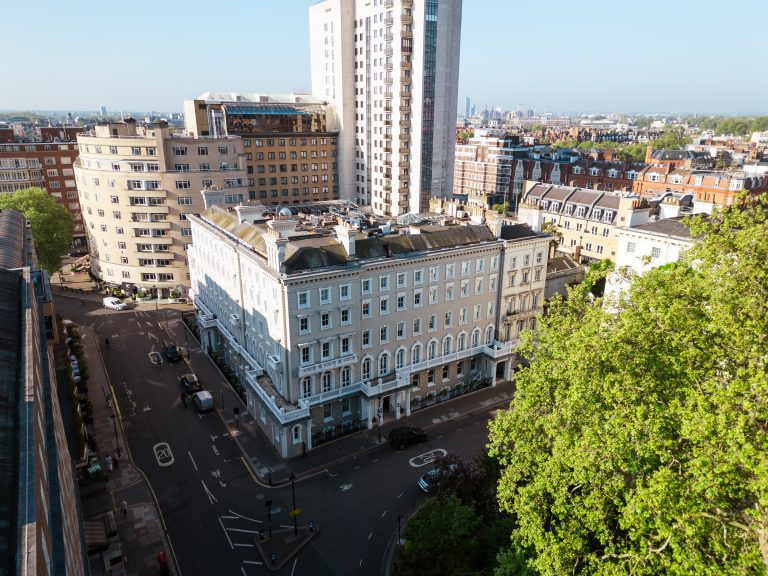
Prime Central London- Belgravia

3. Can Political Uncertainty Affect Pension Funds?

One of the least discussed consequences would be pension market stress. 
 
The UK pension system became acutely exposed during the 2022 gilt crisis under Liz Truss. Liability-driven investment (LDI) strategies created systemic risks when bond yields rose too quickly. 
 
Today, yields are again approaching historically elevated levels amid political instability.   
 
If markets feared: 
 
* unfunded spending promises, 
* fiscal loosening, 
* or leadership chaos, 
 
then pension funds could once again face liquidity pressure. 
 
This would not necessarily create another “mini-budget” moment, but it would remind markets how fragile Britain’s financial plumbing has become. 
 
And this time, investors may react even faster.

4. Business Investment Would Slow Further

Britain already suffers from a long-term investment problem. 
 
Political instability increases hesitation among: 
 
* institutional investors, 
* overseas capital, 
* developers, 
* venture capital, 
* and corporates making long-term decisions. 
 
The IMF recently warned that “domestic uncertainty” could suppress both investment and consumer activity.   
 
When leadership changes become possible every 18–24 months, businesses stop planning long term. 
 
That affects: 
 
* hiring, 
* office demand, 
* infrastructure, 
* regional regeneration, 
* and productivity growth. 
 
Ironically, this becomes self-reinforcing: 
low investment → weak growth → political dissatisfaction → more instability → even lower investment. 

5. The Bank of England Could Be Trapped

A Starmer exit could put the Bank of England in an impossible position. 
 
Normally, central banks cut rates during periods of economic uncertainty. 
 
But if political instability pushes: 
 
* gilt yields higher, 
* sterling lower, 
* and inflation expectations upward, 
 
the Bank may actually need to keep rates elevated for longer.   
 
This is where Britain becomes uniquely vulnerable. 
 
The UK is heavily dependent on: 
 
* imported energy, 
* foreign capital, 
* and confidence in government debt markets. 
 
That means political instability directly feeds into inflation risk faster than in many other developed economies. 

6. Infrastructure and Development Would Slow

Large-scale development depends on confidence and predictability. 

Political transitions create uncertainty around: 
 
* planning reform, 
* housing targets, 
* transport investment, 
* taxation, 
* ESG policy, 
* and public-private partnerships. 
 
Institutional capital hates uncertainty around rules. 
 
A prolonged Labour leadership battle could delay: 
 
* regeneration schemes, 
* infrastructure commitments, 
* pension-backed development, 
* and large mixed-use projects. 
 
The irony is that Britain desperately needs long-term development certainty, especially in housing and infrastructure, but political cycles are becoming increasingly short-term.

7. International Perception of Britain Matters More Than Ever

Global capital increasingly compares countries the same way investors compare companies. 
 
The UK’s reputation for stability was once one of its greatest economic assets. 
 
But since Brexit, the Truss crisis, multiple Prime Ministers, inflation shocks and now renewed leadership instability, investors are beginning to price Britain differently.   
 
This is subtle but important. 
 
If Britain develops a reputation for: 
 
* unstable policymaking, 
* fiscal unpredictability, 
* or constant political churn, 
 
then international investors demand a higher return to invest here. 
 
That affects everything: 
 
* borrowing costs, 
* valuations, 
* development viability, 
* pensions, 
* infrastructure, 
* and ultimately living standards. 

8. What Happens to Property?

Ironically, property becomes both a victim and a beneficiary. 

Negative pressures: 

* Higher borrowing costs 
* Slower growth 
* Reduced domestic affordability 
* Lower consumer confidence 

Positive pressures: 

* Sterling weakness attracting foreign buyers 
* London seen as a global safe-haven asset 
* Inflation hedging demand 
* Supply constraints continuing 


This helps explain why Prime Central London often behaves differently from the broader UK housing market. 

While domestic affordability may weaken during periods of uncertainty, international investors frequently view Prime Central London through a different lens: legal security, global liquidity, currency advantages and long-term scarcity. 

In uncertain periods, these characteristics can become more valuable rather than less. 

Final Thought

The real issue is not whether Starmer leaves. 
 
The real issue is whether Britain can restore long-term economic credibility in an era of permanent political volatility. 
 
Markets can tolerate almost any ideology. What they struggle to tolerate is unpredictability. 
 
And today, the UK’s biggest risk is no longer simply inflation, debt or property affordability. 
 
It is the growing belief that political instability itself is becoming a structural feature of the British economy. 

At The Collaborative London, our Expert Insight Series brings together perspectives from our in-house specialists on the forces shaping property, investment and development. 

In this edition, Co-Founder Abuthar Al-Saraj explores a question rarely discussed in property circles: what happens to the wider economy when political uncertainty increases, and why the property market is often only the final link in a much larger chain reaction. 

Author

Share:

More Posts